When the Talking Circle Took Its Place in Public Meetings
The talking circle in public meetings makes turns easier to see and understand, while revealing why seating alone cannot make a discussion fair.
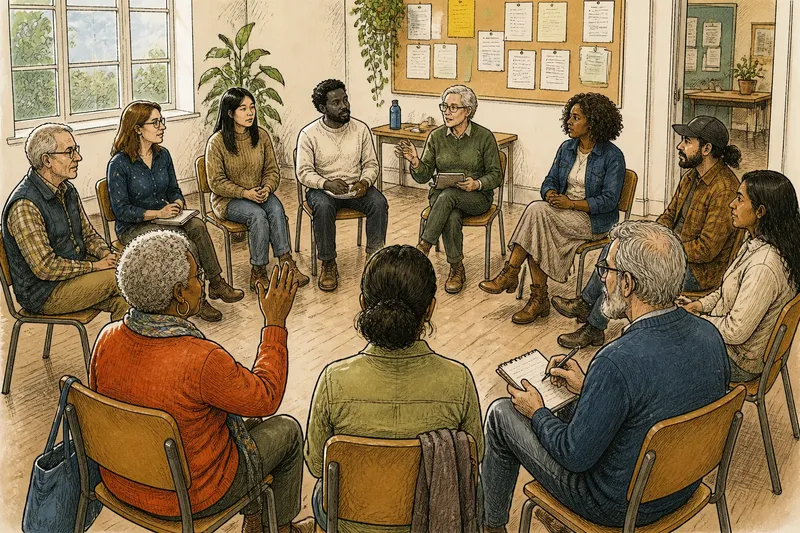
At a neighbourhood meeting, a speaker leans towards the chair while people along the far wall look past one another. Move the chairs into a circle and the room changes: each face becomes easier to see, and the next turn is harder to mistake for a private exchange with the person at the front. The talking circle in public meetings is not simply a seating plan. It is a visible way of arranging attention and access.
What does a circle change in the room?
In rows, people generally face the same direction. The arrangement can suit a presentation, but it also marks out a speaker’s platform and an audience. A circle redistributes that orientation. No seat is automatically the front, and speakers can address the group without turning their backs on most of it.
That shift can make turn-taking easier to follow. Listeners see who is preparing to speak, who has finished, and how others respond. A chairperson can also address the whole group rather than conducting every exchange through a panel or a microphone at the front.
The circle is a cue, not a rule. A person may still dominate, a quiet contribution may still be overlooked, and the meeting may still be controlled by whoever sets the agenda. The shape makes some social signals more visible; it cannot decide what the group will do with them.
How did the arrangement enter public meetings?
There is no single origin story to attach to the public-meeting circle. People have gathered in circles for many purposes across different places and periods, but that broad fact does not make every circle the same practice, or establish one continuous tradition. The useful story here is narrower: circles became one of the arrangements that meeting organisers could choose when they wanted participants to face one another.
As public meetings took shape in civic halls, schools, community rooms and other shared spaces, chairs and tables were practical tools as well as symbols. Rows made it straightforward to direct attention towards a speaker or platform. A ring of chairs made a group discussion more legible as an exchange among participants. Neither arrangement belonged exclusively to a particular kind of society or gathering.
People sometimes refer to circles as though they were a timeless, universal method for fair discussion. That is too sweeping. Seating customs vary, and the meaning of a circle depends on who calls the meeting, who is invited, what decisions are available and how speaking turns are managed. A public meeting can borrow the shape without inheriting any particular cultural practice or set of values.
Who gets the next turn?
In a circle, speakers are easier to see, but there is still a question of how someone gains the floor. Some groups use a chairperson who recognises raised hands. Others pass a speaking object, use a queue, or invite contributions in an agreed order. Each approach changes the pace and the kind of attention the meeting requires.
A hand signal can keep the conversation flexible, though several raised hands may leave the chairperson to judge who was waiting first. A queue makes the order clearer but can be awkward when someone wants to respond briefly to a point already made. A speaking object makes the current turn conspicuous, yet a rigid pass-around may feel slow if the group is large or the topic is urgent.
Imagine a residents’ meeting about a shared courtyard, with chairs in a circle and several people ready to speak. The chairperson says that anyone can raise a hand, then keeps a visible list and checks that a person who has not spoken is not repeatedly passed over. The likely result is a more understandable queue, not equal influence: the agenda and final decision still need to be handled openly.
There is also a difference between an invitation and a demand. Going round the circle in order can ensure each person gets an opening, but it can pressure someone to speak when they would rather pass. Saying “pass is fine” and making the option real gives the round a softer edge. The group should know whether a pass ends that turn or whether the facilitator will return later.
What makes a circle usable rather than symbolic?
Room layout matters before anyone begins speaking. Chairs need enough space for people to enter, leave and move mobility aids; a tight ring can turn a welcoming idea into an obstacle. If tables are needed for papers or translation equipment, a horseshoe or a broken circle may keep faces visible without pretending the room can accommodate a perfect ring.
Hearing and sight matter too. Participants should be able to see the person speaking, and people who rely on assistive listening should be able to access the system the venue provides. In a large room, a portable microphone may be more useful than asking everyone to project. The chairperson can repeat a contribution for the group when that helps, while taking care not to alter its meaning.
Facilitation gives the seating arrangement its working purpose. Before discussion starts, the chairperson can explain how to request a turn, whether contributions have a time boundary, and how the group will handle interruptions. Those small statements replace guesswork with a shared procedure. If the meeting includes a formal vote or a public record, participants should also understand how discussion connects to that process.
Think of the circle as a round table: it puts the paperwork within reach, but it does not decide who gets to sign it. The same is true of a meeting layout. Visibility is useful only when the group also has a way to recognise speakers, hear contributions and make decisions that participants can understand.
What should organisers ask before choosing a circle?
Does a circle suit a large public meeting?
It can, but a very wide ring may make speakers hard to hear and contributions hard to track. Organisers might use several smaller circles for discussion, then bring comments back to the full meeting through an agreed spokesperson or report-back.
Can a circle make a meeting more equal?
It can reduce the visual prominence of a front platform, but it cannot remove differences in confidence, authority or access to the agenda. A clear turn-taking arrangement and an honest account of who makes the decision matter as much as the chairs.
What if participants need different seating arrangements?
Offer a layout with clear sightlines and accessible routes rather than insisting on a complete ring. A horseshoe, paired rows or a central open space may work better for the room and the people using it.
Does every speaker need to go round the circle?
No. A round can help distribute an initial invitation, but participants should be able to pass, and later discussion may work better with a queue or recognised hands. Choose a procedure that fits the purpose of the meeting instead of treating the circle as a fixed ritual.
When is another layout the better choice?
A circle is not automatically the clearest arrangement for every public gathering. If the meeting is mainly a presentation, rows may help people see a screen or speaker. If participants are examining maps, plans or documents together, tables can give them room to work. A mixed format can begin with a short presentation and shift chairs for discussion, provided there is enough space and time to do so without confusion.
Nor should a circle disguise a one-way process. If officials are only giving information and no questions or decisions are possible, say that plainly. Calling a gathering participatory while leaving no route for participants to contribute can make the seating feel like a promise the meeting never intended to keep.
For organisers considering a talking circle in public meetings, the useful question is not whether the shape is inherently fair. Ask what the room lets people see, how they can claim a turn, and what happens to their contributions afterwards. A well-chosen arrangement makes those answers easier to notice—and easier to ask for.